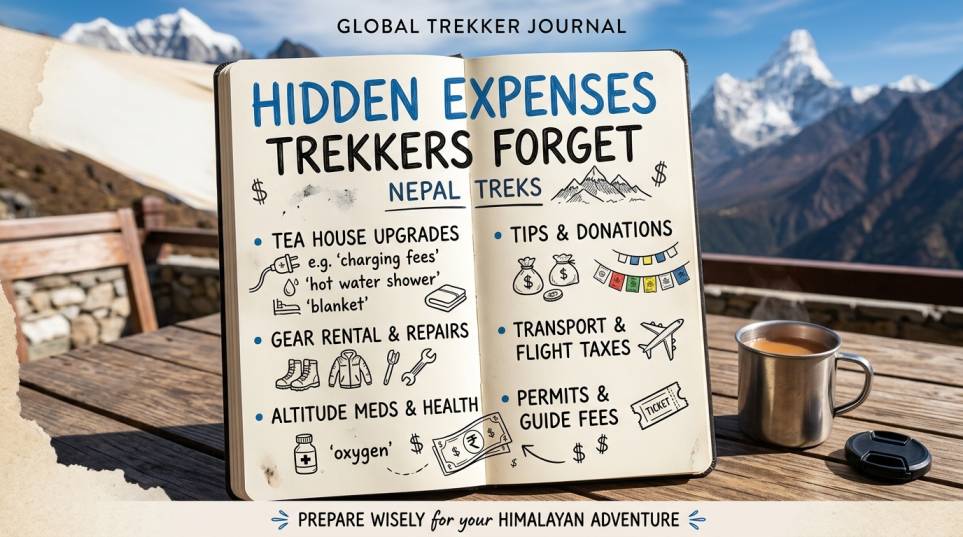
You have budgeted for flights, permits, guide, and meals. You think you have everything covered. Then day 4 hits, and you are paying NPR 500 for a hot shower, NPR 300 to charge your phone, NPR 1,700 for Everest Link Wi-Fi, NPR 200 for toilet paper, and a USD 1,000 helicopter rescue deposit you never saw coming. This guide exposes the 20 hidden expenses most trekkers forget when planning a Nepal trek, with real 2026 prices so you can budget accurately.

On-Trail Hidden Costs (USD 100-300 over a 14-day trek)
These are the small daily expenses that creep up on you at every teahouse. Each looks trivial in isolation, but they add up to USD 100-300 over a 14-day trek — often 10-20% of the total budget. Plan for these explicitly.
| Item | Cost per use (NPR) | 14-day total (USD) | Notes |
|---|---|---|---|
| Hot shower | 200-500 | 25-50 | Daily adds up fast; shower every 2-3 days |
| Phone charging | 100-500 | 15-40 | Daily phone charge; more for camera batteries |
| Wi-Fi (Everest Link) | 1,700 for 10 GB | 15-20 | Buy once at Lukla or Namche |
| Wi-Fi (per day, other regions) | 200-500 | 30-60 | Manaslu, Annapurna, Langtang |
| Toilet paper (1 roll) | 100-200 | 10-20 | Bring your own from Kathmandu |
| Boiled water (1L) | 40-100 | 25-50 | Alternative to bottled water |
| Snacks (chocolate, bars) | 100-300 each | 20-50 | Bring from home or Kathmandu |
| Hot drinks beyond meals | 80-200 | 15-30 | Tea, hot chocolate, lemon ginger |
| Battery rental (power bank) | 200-500/day | 30-50 | If you forget yours |
| Bag storage (Lukla/Pokhara) | 100-300/day | 10-20 | For stuff you leave behind |
Pre-Trek Hidden Costs (USD 80-200)
These costs hit you in Kathmandu before you even reach the trailhead. Most trekkers forget them entirely.
- Nepal visa on arrival: USD 30 (15 days), USD 50 (30 days), USD 125 (90 days). Bring exact cash.
- TIMS card: USD 20 individual, USD 10 group (if not included in package).
- National park permits: USD 30 each (Sagarmatha, Annapurna, Langtang, Manaslu).
- Restricted area permit: USD 75-500 depending on region (Manaslu, Mustang, Dolpo).
- Passport photos: NPR 200-400 for 6 photos (needed for permits).
- Sim card + data: NPR 1,000-1,500 for tourist SIM with 10 GB.
- Gear rental: USD 25-50 for down jacket + sleeping bag rental (14 days).
- Gear purchases: USD 30-100 for trekking poles, duffel, gloves, hat.
- Hotel in Kathmandu: USD 20-50/night if not included in package.
- Tips for hotel staff: NPR 100-200 per service (bellhop, housekeeping).
Emergency Costs (USD 200-10,000 if things go wrong)
These costs are rare but devastating if you are not prepared. Travel insurance with helicopter rescue coverage is non-negotiable for any Nepal trek. Without insurance, you pay these bills yourself.
- Helicopter rescue deposit: USD 1,000-4,000 upfront if insurance is slow to authorize. See our rescue guide.
- Helicopter rescue total cost: USD 5,000-10,000 from EBC to Kathmandu.
- Hospital treatment in Kathmandu: USD 200-2,000 depending on treatment. CIWEC and Norvic are best.
- Medical evacuation to Bangkok: USD 15,000-30,000 for serious cases. Insurance pays if covered.
- Lost trek package (abandoned mid-trek): USD 200-1,000 lost if you cannot continue. Trip cancellation insurance covers this.
- Replacement gear (lost/stolen): USD 100-500 for phone, camera, sleeping bag.
- Emergency accommodation in Kathmandu: USD 50-100/night for extended stay during recovery.
Post-Trek Hidden Costs (USD 50-200)
- Tipping guide and porter: USD 100-200 (10-15% of package cost). See our tipping guide.
- Kathmandu hotel extension: USD 20-50/night if your flight is delayed.
- Domestic flight delays: Extra hotel nights and meals if Lukla flights cancel. Budget USD 50-100/day buffer.
- Laundry in Kathmandu: NPR 100-200 per kg.
- Souvenirs and gifts: USD 50-200 for pashmina, singing bowls, prayer flags, thangkas.
- Airport departure tax: Usually included in your flight ticket, but check.
- Last-night dinner with guide: NPR 1,000-2,000 per person (optional but customary).
The Most Forgotten Costs (and How to Plan for Them)
Based on 100+ treks, here are the five costs that surprise trekkers most:
- Charging fees: USD 25-50 over a 14-day trek. Bring a 20,000 mAh power bank to avoid. See our charging guide.
- Helicopter rescue deposit: USD 1,000-4,000. Carry a credit card with USD 5,000+ available limit.
- Hot showers: USD 25-50. Shower every 2-3 days, not daily.
- Wi-Fi vouchers: USD 15-60. Buy Everest Link at Lukla or Namche, not at teahouses.
- Tipping: USD 100-200. Budget this when you book your trek, not at the end.
How to Build a Realistic Nepal Trek Budget
Use this formula for a realistic 14-day Nepal tea-house trek budget. Take the base package price (say, USD 1,400 for EBC), add 15% for on-trail extras (USD 210), add USD 100 for tipping, add USD 100 for Kathmandu pre-trek costs, add USD 50 for post-trek buffer, and add USD 80 for travel insurance. Total: USD 1,940 — about 40% more than the package price alone. For the full calculator, see our Nepal trekking cost calculator.
Frequently Asked Questions (FAQ)
How much extra money should I bring for hidden costs on a Nepal trek?
Budget USD 200-400 per person on top of your package price for a 14-day tea-house trek. This covers hot showers, charging, Wi-Fi, snacks, drinks, tips, and small emergencies. Carry NPR 30,000-50,000 in cash plus USD 200-400 in backup. See our ATM guide for cash strategy.
Are hidden costs higher on Everest Base Camp or Annapurna treks?
EBC has higher hidden costs due to altitude-related price inflation. Hot showers at Gorak Shep cost NPR 500-700 versus NPR 100-200 in Annapurna. Wi-Fi on EBC (Everest Link) costs USD 15-25 versus free at many Annapurna teahouses. Charging fees are 2-3x higher on EBC. Budget 30-50% more for hidden costs on EBC versus Annapurna.
Should I tip if my package already includes everything?
Yes. Tips are NEVER included in package prices. Budget 10-15% of the package cost for tips, split 60/40 between guide and porter. For a USD 1,400 package, that is USD 140-210 total in tips. See our tipping etiquette guide for exact amounts and protocol.
What happens if I run out of cash on a Nepal trek?
You may have to borrow from your guide (awkward), abandon part of your trek to descend to an ATM (Lukla, Namche, or Pokhara), or ask your agency to wire money (slow and expensive). Avoid this by carrying NPR 40,000-60,000 plus USD 200-400 backup. See our ATM guide for cash planning.
Trek Pathways packages are transparent with no hidden fees. Browse our Manaslu Circuit Trek, Everest Base Camp Trek, or Annapurna Circuit Trek packages and ask for a clear inclusions and exclusions list.
 English
  Deutsch
  Français
  Português
  Español
0 Comment