
Every Nepal trekker faces the same question: do I hire a guide, a porter, or a porter-guide? The choice affects your safety, your budget, and the local economy. This guide breaks down the duties, costs, and trade-offs of each role, with a clear decision matrix so you can pick the right support for your trek.

What Each Role Actually Does
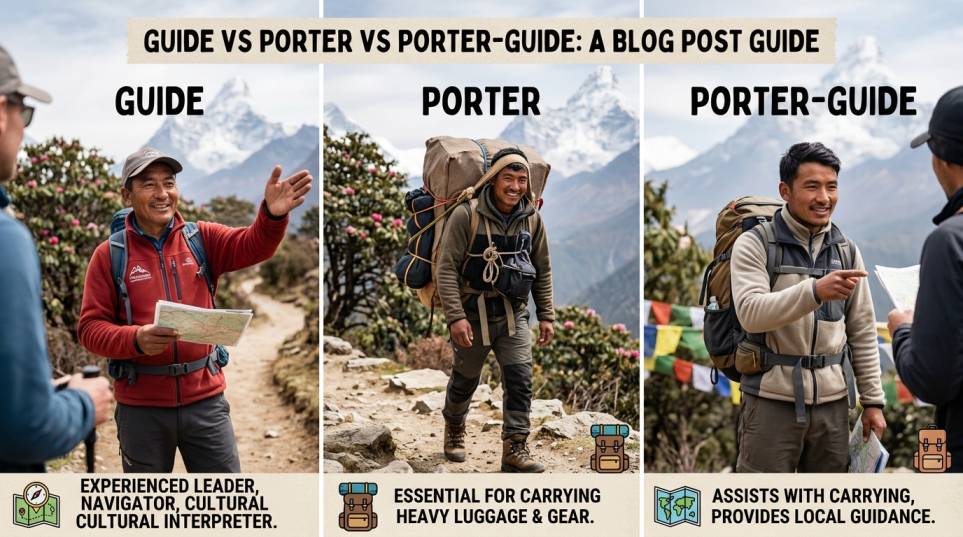
A trekking guide is a licensed professional who leads the group, sets the pace, navigates the trail, communicates with teahouse owners, handles permits, and manages emergencies. Guides speak English (and often other languages), know the local culture and geography, and are trained in first aid and altitude sickness recognition. They do not carry your gear. Cost: USD 25-40 per day.
A porter carries your main duffel (up to 20 kg) from teahouse to teahouse. They walk ahead or behind the group, often on different trails to avoid congestion. Porters usually speak limited English but know the route by heart. They do not guide, navigate, or handle emergencies. Cost: USD 15-20 per day. A porter can carry gear for 1-2 trekkers.
A porter-guide is a hybrid: they carry a light load (10-15 kg, usually their own gear plus some of yours) and also provide basic guiding services. They speak conversational English, know the trail, and can manage routine logistics, but they are not licensed guides and have limited first-aid training. Cost: USD 18-25 per day. Best for solo trekkers or pairs on a budget.
Cost Comparison: Guide vs Porter vs Porter-Guide
| Role | Daily cost (USD) | Carries your gear? | English? | First aid? | Best for |
|---|---|---|---|---|---|
| Licensed guide | 25-40 | No | Fluent | Yes | Groups, remote treks, first-timers |
| Porter | 15-20 | Yes (up to 20 kg) | Limited | No | Anyone wanting to trek light |
| Porter-guide | 18-25 | Yes (10-15 kg) | Conversational | Basic | Solo trekkers, budget pairs |
| Assistant guide | 18-25 | Sometimes | Conversational | Basic | Groups of 5+ |
| Sherpa guide | 30-50 | No | Fluent | Yes | High-altitude passes, technical sections |
When to Hire a Guide (Without a Porter)
Hire a guide-only if you are an experienced trekker who carries your own gear but wants local knowledge, safety support, and cultural translation. This is common on popular routes like Annapurna Base Camp and Langtang Valley where the trail is well-marked and you are comfortable with altitude. The guide walks with you, sets the pace, and handles teahouse logistics, but you carry your own backpack.
When to Hire a Porter (Without a Guide)
Hire a porter-only if you are an experienced trekker who knows the route and altitude management but does not want to carry a heavy pack. This is increasingly rare since the 2023 regulation requiring all trekkers to be accompanied by a licensed guide. However, on non-restricted routes, some trekkers still hire only a porter and trek independently. The porter meets you at each teahouse but does not walk with you. Note: this may not be legally permitted; check current regulations before booking.
When to Hire a Porter-Guide
Hire a porter-guide if you are a solo trekker or a pair on a budget who wants both gear-carrying and basic guiding. A porter-guide carries 10-15 kg (their gear plus some of yours), walks with you, navigates the trail, and handles teahouse bookings. They are the most cost-effective option for solo trekkers on popular routes like EBC, Annapurna Circuit, and Manaslu. For remote or restricted-area treks (Dolpo, Kanchenjunga, Upper Mustang), a licensed guide is strongly recommended over a porter-guide due to safety considerations.
When to Hire Both Guide and Porter
Hire both a guide and a porter if: you are trekking in a group of 3+, you are doing a remote or restricted-area trek, you are a first-time trekker, you want maximum safety and comfort, or you are crossing high passes above 5,000 m. The guide walks with you and handles navigation, safety, and translation. The porter walks separately with the gear. For groups of 4+, add one porter per 2 trekkers. For groups of 6+, add an assistant guide. This is the standard setup for EBC, Manaslu Circuit, and Annapurna Circuit package treks.
Tips for Hiring and Treating Your Guide and Porter
- Book through a registered agency: Ensures fair wages, insurance, and proper gear for the staff.
- Ask about their gear: Porters should have proper boots, jacket, and sleeping bag. If not, your agency should provide.
- Carry their emergency gear: If weather turns bad, give your porter your spare jacket. They are more vulnerable to cold than you.
- Walk at their pace: When walking with your porter-guide, do not push them. They are carrying weight.
- Tip fairly: 10-15% of your total package cost, split 60/40 between guide and porter. See our tipping guide.
- Learn their names: Treat them as colleagues, not servants. They are the reason your trek is possible.
- Pay for their meals: Most agencies include staff meals, but if not, pay for your porter’s meals at teahouses.
Frequently Asked Questions (FAQ)
Do I have to hire a guide in Nepal?
Since April 2023, the Nepal government requires all foreign trekkers to be accompanied by a licensed guide or porter-guide in national parks and conservation areas. Solo trekking is technically no longer permitted. In practice, enforcement is patchy on non-restricted routes, but hiring a guide is strongly recommended for safety, cultural immersion, and supporting the local economy.
How much does a guide cost per day in Nepal?
A licensed English-speaking guide costs USD 25-40 per day, including their meals and accommodation. A guide who speaks German, French, or other languages costs USD 35-50. An assistant guide costs USD 18-25. Sherpa guides for high-altitude or technical sections cost USD 30-50. Most packages include guide fees in the total price.
Can one porter carry gear for two trekkers?
Yes, if each trekker’s duffel is under 10 kg. The International Porter Protection Group limit is 20 kg per porter, which equals 2 standard duffels. For heavier gear or specialty equipment (climbing gear, camera gear), hire one porter per trekker. Always weigh your duffel before leaving Kathmandu.
What is the difference between a guide and a Sherpa?
A guide is a licensed professional of any ethnicity who leads trekkers. A Sherpa is a member of the Sherpa ethnic group from the Khumbu region, often hired as guides for high-altitude treks due to their genetic adaptation to altitude. All Sherpa guides are licensed guides, but not all guides are Sherpas. Sherpa guides typically cost USD 30-50/day versus USD 25-40 for non-Sherpa guides.
Trek Pathways employs licensed local guides and ethical porters on every trek. Browse our Manaslu Circuit Trek, Everest Base Camp Trek, or Annapurna Base Camp Trek packages for a fully-supported Himalayan experience.

 English
  Deutsch
  Français
  Português
  Español
0 Comment