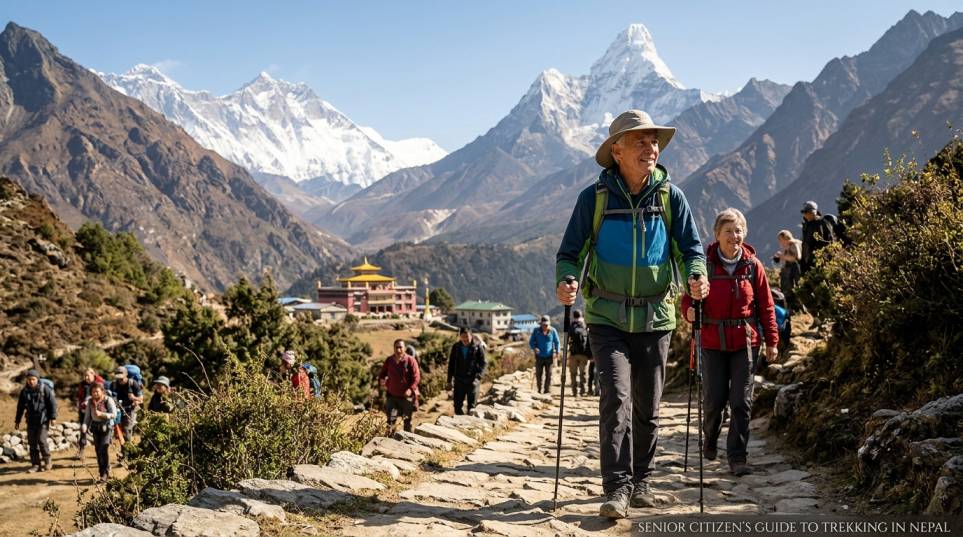
Age is not a barrier to trekking in Nepal. Trekkers in their 60s, 70s, and even 80s successfully complete routes from Poon Hill to Everest Base Camp every year, often outlasting younger trekkers on the trail. The keys are route selection, training, altitude management, and proper insurance. This senior citizen’s guide to Nepal trekking covers everything older trekkers need to know for a safe and rewarding Himalayan adventure.

Best Nepal Treks for Seniors
The best treks for older adults combine gradual ascent, moderate daily altitude gain, comfortable teahouses, and reasonable walking distances (5-6 hours/day maximum). Top recommendations: Poon Hill (3,210 m, 4 days) for beginners and those with knee issues; Langtang Valley (3,870 m, 7 days) for cultural immersion and gradual ascent; Annapurna View Trek (2,500 m, 5 days) for low altitude and easy walking; and Everest View Trek (3,880 m, 7 days) for Sherpa culture without the altitude of EBC.
| viaje difícil | Altitud máxima | Duración | Daily walking | Senior rating |
|---|---|---|---|---|
| colina de palo | 3.210 m | 4 días | 4-5 hrs | Excellent — short, low altitude |
| Annapurna View | 2,500 m | 5 days | 4-5 hrs | Excellent — very low altitude |
| Valle De Langtang | 3.870 m | 7 días | 5-6 hrs | Very good — gradual ascent |
| Everest View | 3.880 m | 7 días | 5-6 hrs | Very good — Lukla flight, cultural |
| helambú | 3.650 m | 6 días | 5-6 hrs | Good — close to Kathmandu |
| Caminata real | 1.730 m | 4 días | 3-4 hrs | Excellent — easiest option |
| EBC (with extras) | 5.364 m | 16 days | 5-7 hrs | Challenging — only for fit seniors |
For seniors attempting EBC or Manaslu Circuit, add 2-3 extra acclimatization days to standard itineraries. Trek with a private guide rather than joining a group, so you control the pace. Consider the Caminata de lujo en Manaslu or EBC Luxury Lodge Trek for higher comfort levels.
Training and Preparation for Senior Trekkers
Start training 3-6 months before your trek. Focus on three areas: cardiovascular endurance (walking, hiking, cycling, swimming 3-4 times per week), leg strength (squats, lunges, step-ups), and balance (yoga, tai chi, single-leg stands). Walk 5-10 km per session with a 5 kg daypack, gradually increasing distance and pack weight. Practice on stairs and inclines to simulate Nepal’s steep trails. Get a complete medical checkup including cardiac stress test, especially if you have any history of heart disease, hypertension, or respiratory issues.
Discuss altitude plans with your doctor, especially if you take blood pressure medication, blood thinners, or diabetes medication. Some medications need dose adjustment at altitude. Carry a doctor’s letter listing your medications and conditions, in case of emergency. See our Cronología de planificación de Trek for a 6-month preparation schedule.
Altitude Management for Seniors
Seniors acclimatize to altitude at the same rate as younger adults, but they often have less cardiovascular reserve to compensate for altitude stress. The 500-meter rule is non-negotiable: gain no more than 500 m of sleeping altitude per day above 3,000 m, and add a rest day every 1,000 m. Carry Diamox (125 mg twice daily from 3,000 m), with your doctor’s approval. Monitor oxygen saturation with a portable pulse oximeter (USD 25 on Amazon); below 85% at rest is a warning sign.
Gear Specific to Senior Trekkers
- Trekking poles (2): Essential for knee protection on descents. Black Diamond Distance Carbon or Leki Makalu.
- Lightest possible pack: Hire a porter for your main duffel. Carry only 3-4 kg in your daypack.
- Quality boots with maximum cushioning: Hoka Kaha, Lowa Renegade, Salomon X Ultra. Replace worn-out boots before the trek.
- Compression socks: Reduce swelling and DVT risk on long flights.
- Pulse oximeter: USD 25, fits on keychain. Check oxygen saturation 2x daily above 3,500 m.
- Personal medication organizer: Clearly labeled with medication names and dosages.
- Extra layers: Seniors feel cold more acutely. Bring one more layer than younger trekkers.
Insurance Considerations for Senior Trekkers
Travel insurance premiums increase significantly for trekkers over 65, and many standard policies cap trekking altitude at 3,000 m or exclude pre-existing conditions. Look for senior-specific adventure travel insurance: World Nomads Explorer covers trekkers to age 70 with no altitude limit; IMG Patriot Senior covers to age 79 with altitude coverage to 4,500 m; battleface covers to age 79 with altitude coverage to 6,000 m+. Always declare pre-existing conditions; failure to do so invalidates coverage. For full details, see our Guía de seguros.
Safety Tips for Senior Trekkers
- Trek with a private guide: Not a group. Set your own pace, take extra rest days.
- Carry medical info: Bracelet or card listing blood type, medications, conditions, emergency contact.
- Monitor hydration: Dehydration worsens altitude sickness. Drink 3-4 liters per day.
- Protect knees on descents: Use trekking poles, take short steps, rest frequently.
- Listen to your body: Stop if you feel chest pain, severe breathlessness, or dizziness. Descend.
- Trek in shoulder season: October-November or March-April. Avoid peak cold (Dec-Feb) and monsoon (Jun-Sep).
- Choose teahouses with care: Pick ones with attached bathrooms and gas-heated showers for comfort.
- Plan rest days generously: Add 1-2 extra acclimatization days to standard itineraries.
Preguntas más Frecuentes (FAQ)
What is the maximum age for trekking in Nepal?
There is no legal maximum age. Trekkers in their 70s and 80s complete EBC and other Nepal treks every year. The deciding factor is fitness and health, not age. Always get medical clearance from your doctor before booking, and choose age-appropriate routes.
Can a 70-year-old trek to Everest Base Camp?
Yes, with proper preparation. Many trekkers aged 70+ complete EBC each year. The keys are: 6 months of training beforehand, a slow itinerary with 3+ acclimatization days, a private guide, lightweight pack (porter-carried), and comprehensive insurance. Consider the luxury lodge version for higher comfort.
Are there medical facilities on Nepal trekking routes?
Limited. Himalayan Rescue Association clinics operate in Manang, Pheriche, and Everest ER in Lukla during peak season. These are basic facilities for altitude sickness and minor injuries. Serious cases require helicopter evacuation to Kathmandu. Always carry travel insurance with helicopter rescue coverage.
Is altitude more dangerous for seniors?
Not necessarily, but seniors have less cardiovascular reserve to compensate for altitude stress. The 500-meter rule (no more than 500 m sleeping altitude gain per day above 3,000 m) is essential. Carry Diamox (with doctor’s approval) and a pulse oximeter. Descend immediately if oxygen saturation drops below 80% or symptoms appear.
Trek Pathways offers senior-friendly Nepal treks with private guides, slow pacing, and comfort-focused teahouses. Browse our Valle De Langtang Trek, Annapurna Trek Expresso Caminata de lujo en Manaslu for a safe and rewarding Himalayan adventure for older trekkers.

 English
  Deutsch
  Français
  Português
  Español
0 Comment