
Your boots will make or break your Nepal trek. The wrong pair can leave you with blisters by day 3, frostbitten toes at 5,000 m, or a sprained ankle on a Manaslu scree slope. This guide explains exactly how to choose the right trekking boots for Nepal, whether you are heading to Everest Base Camp, the Annapurna Circuit, or a winter Manaslu crossing.

What Makes a Boot Suitable for Nepal Trekking?
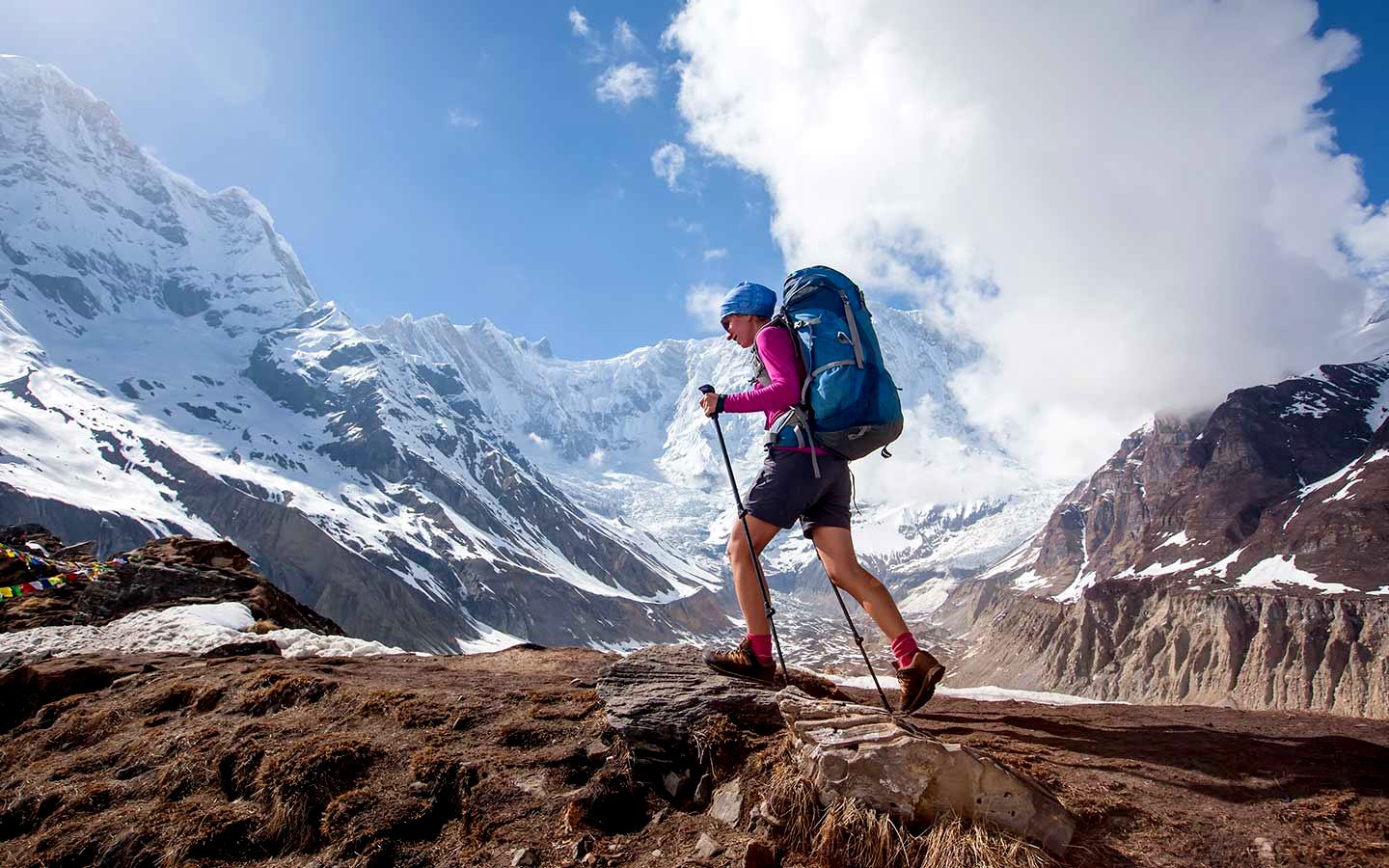
Nepal trails are a mix of paved paths, rocky steps, scree, river crossings, snow at high passes, and long steep descents. Your boots need three things: aggressive grip (Vibram or equivalent), ankle support to prevent sprains on uneven terrain, and a stiff enough sole to protect your feet on rocky descents. Lightweight trail shoes are fine for Annapurna Base Camp but dangerous on Manaslu’s Larke Pass or EBC’s Cho La Pass.
Most Nepal treks require a B0 or B1-rated boot. B0 boots are flexible and ideal for well-maintained trails like Annapurna Base Camp and Langtang Valley. B1 boots are stiffer, suitable for Manaslu Circuit, Annapurna Circuit, and Everest Base Camp. B2 and B3 boots are for technical mountaineering and overkill for regular tea-house treks. If you plan to cross a high pass like Larke La (5,160 m) or Kongma La (5,535 m), a B1 boot with crampon compatibility is your safest choice.
Waterproof vs Non-Waterproof Boots
For Nepal trekking, waterproof boots (Gore-Tex or similar membrane) are almost always the right choice. You will cross glacial streams, walk through morning dew on grassy trails, and possibly encounter snow on high passes. A wet foot on day 1 becomes a blistered foot by day 3. The downside of waterproof boots is that they breathe less in hot low-altitude sections, but this is a small trade-off for dry feet on a 14-day trek.
Non-waterproof boots are only recommended for the Annapurna Base Camp trek in peak dry season (October-November) when river crossings are bridged and rain is unlikely. Even then, morning dew can soak your feet. Bring waterproof boots unless you are absolutely certain of dry conditions.
Fit and Sizing: The Most Important Factor
Your feet swell at altitude and on long descents. Buy trekking boots one half-size or one full-size larger than your street shoes. There should be a thumb’s width of space between your longest toe and the end of the boot when you stand up. Try boots on in the afternoon (when your feet are largest) with the socks you plan to wear on the trek, including a liner sock if you use one. Walk up and down a steep ramp in the store to test for heel slip and toe bang.
- Heel lock: Your heel should not lift more than 5 mm when walking uphill. Lifting causes blisters.
- Toe box space: Toes should not touch the front on steep descents. Trim your toenails short before the trek.
- Arch support: The boot’s arch should match your foot’s natural arch. Add Superfeet or similar insoles if needed.
- Ankle mobility: You should be able to flex forward naturally, but the boot should resist sideways roll.
- Sock pairing: Test with a merino wool trekking sock (Smartwool, Darn Tough) plus a thin liner sock.
Breaking In Your Boots Before Nepal
Never take brand-new boots on a Nepal trek. Break them in over at least 4-6 weeks of regular wear, including several 4-6 hour hikes with a loaded daypack. Start with short walks, then progress to long uphill and downhill hikes. Pay attention to hot spots and address them with moleskin or Leukotape before they become blisters. A properly broken-in boot feels like an extension of your foot by the time you land in Kathmandu.
Recommended Trekking Boots for Nepal (2026)
| Boot | Rating | Best for | Price (USD) |
|---|---|---|---|
| Salomon X Ultra 4 Mid GTX | B0 | Annapurna BC, Langtang, Poon Hill | 180 |
| La Sportiva Ultra Raptor II Mid | B0 | All Nepal teahouse treks | 200 |
| Lowa Renegade GTX Mid | B0/B1 | EBC, Annapurna Circuit | 230 |
| La Sportiva Trekker GTX | B1 | Manaslu, EBC, Annapurna Circuit | 240 |
| Scarpa Zodiac Plus GTX | B1 | High passes, Manaslu, EBC | 260 |
| Lowa Camino GTX | B1 | Long 14+ day treks, heavy loads | 280 |
| Salomon Quest 4 GTX | B1 | All-round rugged trekking | 230 |
Renting boots in Kathmandu is not recommended for treks longer than 5 days. Rented boots are not broken in to your foot shape and often lead to severe blisters. For gear rental tips, see our renting vs buying gear guide.
Socks and Foot Care on the Trail
Bring 3-4 pairs of merino wool trekking socks (Smartwool, Darn Tough, Icebreaker). Merino regulates temperature, wicks sweat, and resists odor for days. Rotate pairs daily and dry them inside your sleeping bag at night. Add a thin polypropylene liner sock to prevent friction blisters. Carry a small foot-care kit with Leukotape, Compeed hydrocolloid plasters, antiseptic cream, and nail clippers. Treat any hot spot immediately; do not wait for it to become a blister.
Frequently Asked Questions (FAQ)
Can I wear trail running shoes instead of boots in Nepal?
Only on well-maintained treks like Annapurna Base Camp and Poon Hill in dry season. For Manaslu, EBC, or any trek with high passes above 5,000 m, proper trekking boots with ankle support are essential. Trail shoes lack the stiffness and ankle protection needed for scree and snow.
Should I buy boots in Kathmandu to save money?
You can find quality boots in Kathmandu (like Shonas store in Thamel) but selection is limited and sizes run small. Buying boots at home ensures proper fit and break-in time. Bring your boots with you; rent other gear in Kathmandu.
How long do trekking boots last on Nepal trails?
A quality pair of trekking boots lasts 800-1,500 km of trail use, roughly 4-6 Nepal treks. The Vibram outsole wears first, followed by the midsole cushioning. If you feel rocks through the sole or the tread is worn smooth, it is time to replace them.
Are crampons needed for Nepal tea-house treks?
Generally no, but lightweight microspikes (Kahtoola KTS, 250 g) are useful for crossing high passes in winter or early spring. Bring microspikes for Manaslu’s Larke Pass in November-December or March-April. Full crampons are only needed for technical peaks like Island Peak or Mera Peak.
Once your boots are sorted, pack them with everything else on our Nepal trekking packing checklist, then book your trek. Browse our Manaslu Circuit Trek or Annapurna Circuit Trek packages today.

 English
  Deutsch
  Français
  Português
  Español
0 Comment