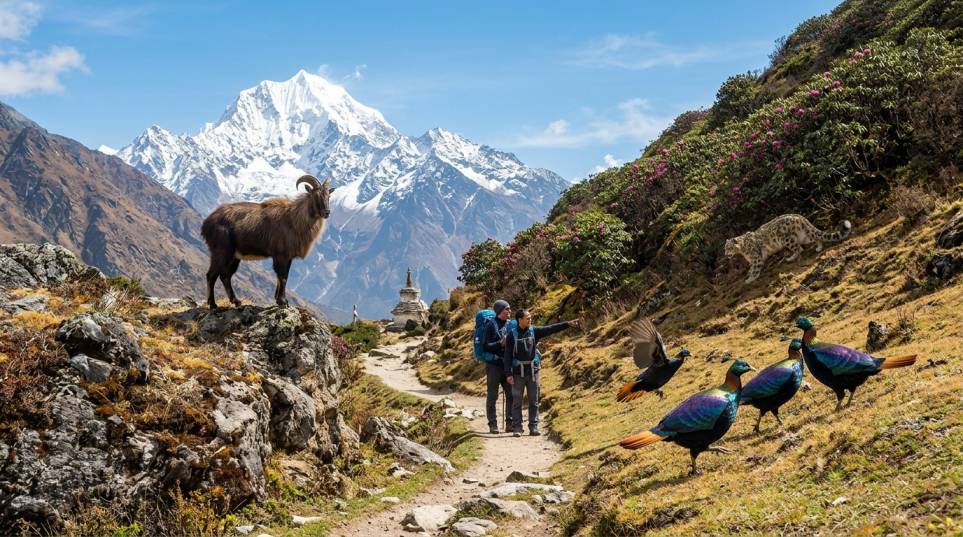
Nepal is one of the most biodiverse countries on earth for its size, with habitats ranging from tropical lowland jungle (100 m) to alpine tundra (5,000+ m). Trekking here puts you in the home of the snow leopard, red panda, Himalayan tahr, musk deer, and hundreds of bird species. This guide covers the wildlife you can see on Nepal treks, where to spot them, and how to increase your chances of an unforgettable encounter.

Mammals You Can See on Nepal Treks
The Himalayas are home to over 300 mammal species, but most are elusive and endangered. Trekkers most commonly see Himalayan tahr (mountain goats grazing on cliff faces), blue sheep (bharal) in the Manaslu and Dolpo regions, musk deer in the rhododendron forests, and yaks (domesticated, but iconic). Luckier trekkers may spot a red panda in Langtang National Park, a snow leopard in Upper Mustang or Dolpo, or a Himalayan black bear in the Annapurna foothills.
| Animal | Region | Altitude | Best season | Likelihood |
|---|---|---|---|---|
| Himalayan tahr | Everest, Annapurna | 2,500-4,500 m | Spring, autumn | Common |
| Blue sheep (bharal) | Manaslu, Dolpo, Mustang | 3,000-5,500 m | Spring, autumn | Common |
| Musk deer | Annapurna, Langtang | 2,500-4,000 m | Spring, autumn | Occasional |
| Red panda | Langtang | 2,500-4,000 m | Spring | Rare |
| Snow leopard | Mustang, Dolpo, Manaslu | 3,000-5,500 m | Winter | Very rare |
| Himalayan black bear | Annapurna, Langtang | 2,000-3,500 m | Autumn | Rare |
| Yellow-throated marten | All regions | 1,500-3,500 m | All year | Common |
| Assam macaque | Langtang, Annapurna | 1,500-3,000 m | All year | Common |
| Pika | All high-altitude regions | 3,000-5,000 m | All year | Common |
| Wild yak | Dolpo, Mustang | 4,000-5,500 m | Autumn | Rare (domesticated common) |
Birds of the Nepal Himalayas
Nepal has recorded over 900 bird species, more than any other country in Asia. Trekking routes put you in habitat for the Himalayan monal (danphe, Nepal’s national bird), blood pheasant, Himalayan griffon vulture, lammergeier (bearded vulture), and the colorful Tibetan snowcock. Bring binoculars (8×42 or 10×42) and a copy of “Birds of Nepal” by Grimmett, Inskipp, and Inskipp. The best birding routes are Langtang Valley, Annapurna Conservation Area, and the lower Solu region.
- Himalayan monal (danphe): National bird of Nepal, rainbow-colored, found in rhododendron forests 2,500-4,500 m.
- Blood pheasant: Red-breasted, found in damp forests 3,000-4,500 m.
- Lammergeier: Bearded vulture with 2.8 m wingspan, seen soaring above all high-altitude routes.
- Himalayan griffon: Large vulture, often seen in groups above Namche and Manang.
- Tibetan snowcock: Large partridge-like bird above 4,000 m on Manaslu and EBC routes.
- White-capped redstart: Common near streams and rivers on all treks.
- Rufous-gorgeted flycatcher: Common in oak-rhododendron forests 2,000-3,000 m.
The Snow Leopard: Himalayan Holy Grail
The snow leopard is the most sought-after wildlife sighting in the Himalayas. There are an estimated 350-500 snow leopards in Nepal, mostly in the Mustang, Dolpo, Manaslu, and Kanchenjunga regions. They are extremely elusive and sightings are rare — perhaps 1 in 100 trekkers in snow leopard habitat ever sees one. Winter (December-February) increases chances as snow leopards descend to lower altitudes following prey. For dedicated snow leopard tracking, visit Upper Mustang in winter with a specialized wildlife guide.
Even without seeing a snow leopard, you can spot their tracks in snow and their kills (blue sheep carcasses in trees). Local herders and guides are your best spotters; ask them. The Snow Leopard Conservancy in Ladakh and the Upper Mustang region offer the best chances. Always carry binoculars and scan ridgelines at dawn and dusk.
Best Treks for Wildlife Watching
Different treks offer different wildlife. For Himalayan tahr and birds, the Everest region is excellent. For blue sheep and snow leopards, choose Manaslu Circuit, Upper Mustang, or Upper Dolpo. For red pandas, Langtang Valley is your best bet. For rhinos, tigers, and elephant, add Chitwan or Bardia National Park to your itinerary as a safari extension.
| Trek | Best for | Highlight species |
|---|---|---|
| Everest Base Camp | Tahr, birds | Himalayan tahr, lammergeier, monal |
| Annapurna Circuit | Pheasants, tahr | Monal, blood pheasant, tahr |
| Manaslu Circuit | Blue sheep, leopard habitat | Blue sheep, possible snow leopard tracks |
| Langtang Valley | Red panda, monkeys | Red panda, Assam macaque, langur |
| Upper Mustang | Snow leopard, blue sheep | Snow leopard (winter), blue sheep |
| Upper Dolpo | Snow leopard, blue sheep | Snow leopard (winter), wild yak |
| Kanchenjunga | Red panda, leopard habitat | Red panda, snow leopard tracks |
Wildlife Watching Tips for Trekkers
- Carry binoculars: 8×42 or 10×42. Essential for spotting distant animals.
- Walk quietly: Talk in whispers, especially at dawn and dusk when animals are active.
- Use dawn and dusk: Most mammals are crepuscular. Plan early starts and evening walks.
- Scan ridgelines: Snow leopards and tahr prefer cliff edges for vantage points.
- Look for tracks: In snow and mud. Pug marks indicate predator presence.
- Hire a wildlife guide: Specialized guides know habitats and recent sightings.
- Wear muted colors: Avoid bright red, yellow, white. Earth tones blend in.
- Stay still: If you spot an animal, freeze. Movement scares them off.
- Respect distance: Never approach wildlife closer than 100 m. Use binoculars to see more.
Frequently Asked Questions (FAQ)
Can you see snow leopards while trekking in Nepal?
Yes, but rarely. There are an estimated 350-500 snow leopards in Nepal, mostly in Mustang, Dolpo, Manaslu, and Kanchenjunga. Winter (December-February) increases chances as they descend to lower altitudes. Dedicated snow leopard tracking tours in Upper Mustang offer the best odds, but sightings are never guaranteed.
Where can I see red pandas in Nepal?
Langtang National Park is the best trekking destination for red panda sightings, particularly in the bamboo and rhododendron forests between Ghoda Tabela and Kyanjin Gompa (2,500-4,000 m). Spring (March-May) is the best season. Other red panda habitats include the Kanchenjunga region and the Ilam district in eastern Nepal.
Are there dangerous animals on Nepal trekking routes?
Encounters with dangerous animals are rare on established trekking routes. Himalayan black bears can be aggressive if surprised; make noise when walking through dense forest in the Annapurna and Langtang regions. Wild boars can be aggressive when with young. Snakes are rare at altitude. Wolves and snow leopards avoid humans. Always give wildlife space and never approach.
Can I add a wildlife safari to my Nepal trek?
Yes. Chitwan National Park (5-6 hours from Kathmandu or 25-minute flight) and Bardia National Park (12 hours from Kathmandu or 1-hour flight to Nepalgunj) offer jungle safaris for rhino, tiger, elephant, and crocodile. Most trekking agencies can add a 2-3 day safari extension to your itinerary. Trek Pathways offers combined trek + safari packages.
Trek Pathways offers wildlife-focused Nepal treks with expert naturalist guides. Browse our Langtang Valley Trek for red pandas, Manaslu Circuit Trek for blue sheep, or Upper Mustang Trek for snow leopard habitat.

 English
  Deutsch
  Français
  Português
  Español
0 Comment