
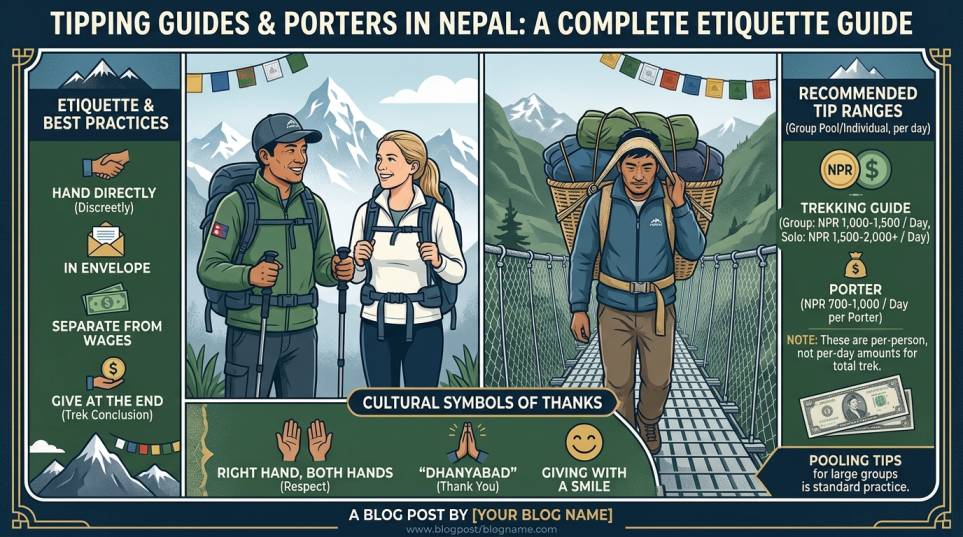
Tipping is expected on every Nepal trek, but the amounts and etiquette confuse most first-time visitors. Tip too little and you undervalue the staff who made your trek possible. Tip too much and you distort local wage expectations. This complete tipping etiquette guide gives you the exact amounts, the cultural context, and the proper way to deliver tips so they are received with respect.

Why Tipping Matters in Nepal
Nepal’s trekking industry runs on a wage-plus-tips model. Guides earn USD 25-40 per day, porters USD 15-20 per day, and these wages have not kept pace with inflation. Tips make up 20-40% of their actual take-home income. Without tips, guides and porters cannot support their families, send children to school, or save for the off-season (when most trekking work disappears for 4 months). Tipping is not optional; it is a core part of the trekking economy.
Tipping also signals respect. A generous tip tells your guide and porter that you valued their work, their care, and their company. It is given publicly, with both hands, and accompanied by thanks. Nepali culture places high value on relationships and reciprocity; a fair tip cements the bond between trekker and guide, often leading to lifelong friendships and return visits. For more on the trekking economy, see our trekking cost calculator.
How Much to Tip: The Standard Rates
| Role | Per day (USD) | 14-day trek (USD) | Notes |
|---|---|---|---|
| Licensed guide | 5-8 | 70-112 | Tip on the higher end for exceptional service |
| Assistant guide | 4-6 | 56-84 | One per 4-5 trekkers |
| Porter | 3-5 | 42-70 | Tip per porter, not per trekker they serve |
| Porter-guide | 4-6 | 56-84 | Hybrid role, between guide and porter |
| Sherpa guide | 6-10 | 84-140 | Higher rate for high-altitude expertise |
| Cook (camping treks) | 4-6 | 56-84 | Camping treks only |
| Kitchen staff | 2-3 | 28-42 | Camping treks only |
The standard calculation is 10-15% of your total package cost, split 60% to the guide and 40% to the porter. For a USD 1,500 EBC trek package, that is USD 150-225 total: USD 90-135 to the guide and USD 60-90 to the porter. If you have an assistant guide, split the guide’s share. If you have multiple porters, divide the porter share equally. Always tip in Nepali rupees, not USD, to avoid currency exchange hassles for the staff.
When to Tip: The Last Day Protocol
Tip on the last evening of your trek, after dinner, at the final teahouse or back in Lukla/Pokhara/Kathmandu. Gather your guide, assistant guide, and porters together in the dining hall. Hand each person their tip in a sealed envelope with both hands (the Nepali gesture of respect) and say “dhanyabad” (thank you). For groups, collect tips from all trekkers in advance and present a single envelope to each staff member. This avoids awkwardness and ensures no one is missed.
Avoid tipping mid-trek. Mid-trek tips can be misinterpreted as a sign you want special treatment, and they create awkwardness if service declines later. If a guide or porter does something exceptional mid-trek (saves your life, carries your pack when you are sick), offer a small gift (chocolate, energy bar, your spare buff) rather than cash, and save the cash tip for the end.
How to Tip: Cultural Etiquette
- Tip in NPR cash: USD is harder for staff to exchange in villages. Convert at a money changer in Kathmandu.
- Use sealed envelopes: Each tip in a separate envelope with the recipient’s name. Avoid handing over loose cash.
- Give with both hands: Or with the right hand touching the left elbow. This is the Nepali gesture of respect.
- Say “dhanyabad”: (Pronounced “than-yah-bad”). Means “thank you”. Add “timi lahagi” (for you) for warmth.
- Tip publicly: In front of the group, so all staff see each other being treated fairly. No secret envelopes.
- Do not bargain down your tip: If service was bad, talk to the agency. Do not punish the staff for issues outside their control.
- Tip individually: Hand each staff member their envelope directly. Do not give one big envelope to the guide to distribute.
What If Service Was Bad?
If your guide or porter was genuinely negligent, rude, or put you in danger, you are not obligated to tip the full amount. However, do not skip the tip entirely without explanation. Talk to your trekking agency in Kathmandu, explain the issue in writing, and let them adjust. Reducing a tip without telling the staff why creates resentment and damages the next trekker’s experience. For tips on choosing a reliable agency in the first place, see our trekking company guide.
Beyond Cash: Meaningful Gifts for Guides and Porters
Cash is king, but small gifts are appreciated and often more memorable. Quality gear that you no longer need is gold: a barely-used down jacket, trekking poles, a headlamp with spare batteries, quality merino socks, a Swiss army knife, or a spare Nalgene bottle. Avoid giving cheap souvenirs from home; they have no practical use in Nepal. For children of staff (if you meet them), school supplies like pens, notebooks, and colored pencils are treasured. Never give candy to village children; it contributes to dental problems.
Frequently Asked Questions (FAQ)
Is tipping mandatory on Nepal treks?
Culturally, yes. Trekking staff rely on tips for 20-40% of their income. While not legally mandatory, not tipping is considered extremely poor form and exploitative. Budget 10-15% of your total package cost for tips when planning your trek.
Should I tip in USD or NPR?
Nepali rupees (NPR). USD is harder for staff to exchange in villages, and money changers take a 3-5% commission. Convert your tip budget at a money changer in Kathmandu before departing for the trail. Carry small NPR notes (100s and 500s) for the envelopes.
How much should I tip my guide for a 14-day trek?
USD 70-112 per trekker for a licensed guide (USD 5-8 per day). For a couple trekking together, that is USD 140-224 total for the guide. If you also have a porter, add USD 42-70 per trekker. For a couple with both guide and porter, total tips run USD 200-300 for the 14-day trek.
Can I tip with gear instead of cash?
Yes, as a supplement to cash, not a replacement. Quality used gear (down jacket, trekking poles, headlamp, merino socks) is highly valued by trekking staff. But cash is still needed for family expenses, school fees, and off-season survival. Give gear as a bonus, not in place of cash.
Trek Pathways packages include a recommended tipping guide and pre-departure briefing on local etiquette. Browse our Manaslu Circuit Trek, Everest Base Camp Trek, or Annapurna Circuit Trek packages today.

 English
  Deutsch
  Français
  Português
  Español
0 Comment