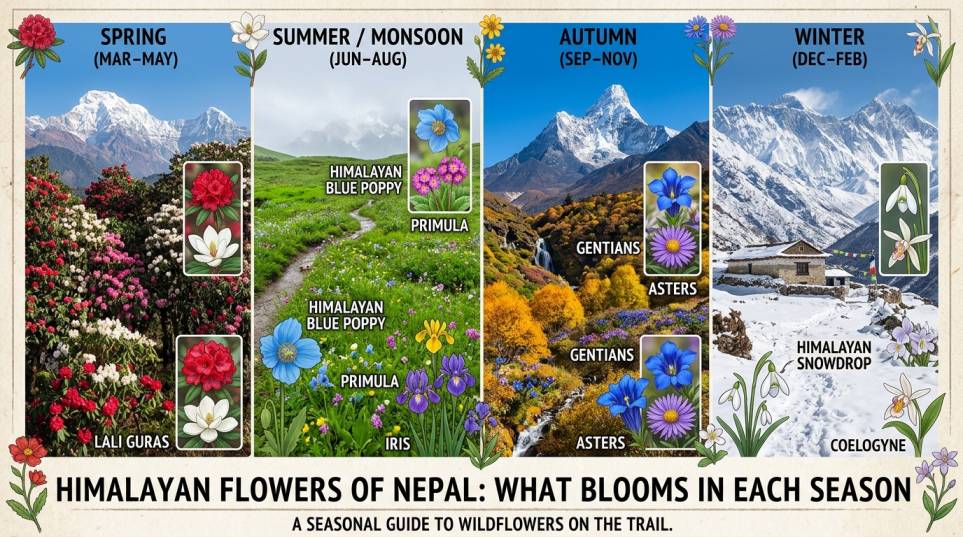
Nepal has over 6,000 flowering plant species, including 350 species of orchids and the national flower, the rhododendron (Lali Gurans). Trekking through different altitudes and seasons exposes you to completely different floral displays — from the famous red rhododendron forests of March-April to the delicate blue poppies of July-August. This guide covers what blooms when, and which treks offer the best flower watching.

Spring Blooms (March-May): Rhododendron Season
Spring is the most spectacular season for Himalayan flowers. The rhododendron (Lali Gurans) blooms in March and April, covering hillsides in red, pink, and white from 1,500 m to 4,000 m. Nepal has 30 rhododendron species, more than any country in the world. The Annapurna, Langtang, and Manaslu regions have particularly dense rhododendron forests. Other spring blooms include magnolias (March-April), wild cherry blossoms (March), and primulas (April-May).
- Rhododendron arboreum: Nepal’s national flower. Red, pink, white blooms. 1,500-3,600 m.
- Magnolia campbellii: Large pink-white flowers before leaves appear. 2,400-3,000 m.
- Wild cherry (Prunus cerasoides): Pink blossoms in March. 1,500-2,400 m.
- Primula denticulata: Drumstick primula, purple-pink. 2,400-4,000 m.
- Primula wollastonii: Blue-violet, found near snowmelt. 4,000-5,000 m.
- Iris decora: Purple iris on dry slopes. 2,000-3,500 m.
- Berberis: Yellow flowers on barberry shrubs. 2,500-4,000 m.
Summer Blooms (June-August): Monsoon Magic
The monsoon brings rain but also the most delicate and sought-after Himalayan flowers. The Himalayan blue poppy (Meconopsis) blooms in July-August at 4,000-5,000 m, with translucent blue petals that seem to glow. Other summer blooms include various gentians, orchids, edelweiss, and the rare snow lotus (Saussurea). While trekking is wetter and leeches are present below 3,000 m, the floral display is unmatched. The best summer flower treks are in the rain-shadow regions: Upper Mustang, Upper Dolpo, and parts of Manaslu’s Tsum Valley.
- Himalayan blue poppy (Meconopsis aculeata): Iconic blue flower. 4,000-5,000 m. July-August.
- Snow lotus (Saussurea gossypiphora): Woolly white flower. 4,000-5,500 m. August.
- Gentiana: Trumpet-shaped blue-purple flowers. 3,000-5,000 m. July-September.
- Edelweiss (Leontopodium): Felted white flower. 3,000-5,000 m. July-August.
- Cypripedium himalaicum: Lady’s slipper orchid. 3,000-4,000 m. June-July.
- Pedicularis: Lousewort, spikes of pink-purple. 3,000-5,000 m. July-August.
- Anemone: White or purple flowers. 3,000-5,000 m. July-August.
Autumn Blooms (September-November): Less Show, Still Beautiful
Autumn is the driest and most popular trekking season, but it has fewer flowers than spring and summer. Most plants have finished blooming by October. However, you can still find late-blooming asters, gentians, and saussurea. Autumn’s floral highlight is the changing leaf color: birch trees turn gold, buckwheat fields in Manaslu and Annapurna turn red, and larch (the only deciduous conifer in Nepal) turns yellow in the Manaslu region.
Winter (December-February): Minimal but Special
Winter is the least flowery season above 2,000 m, with most plants dormant under snow. But you can find winter jasmine (Jasminum humile) and winter flowering cherry in lower valleys. The real winter highlight is the silhouette of bare rhododendron trees against snow, especially in Annapurna’s Ghorepani area. Below 1,500 m, winters are mild and many subtropical flowers bloom year-round, including bougainvillea, hibiscus, and marigolds.
Best Treks for Himalayan Flower Watching
| Trek | Best season | Highlight flowers | Altitude range |
|---|---|---|---|
| Annapurna Base Camp | March-April | Rhododendron forests, primula, magnolia | 1,000-4,100 m |
| Langtang Valley | April-May | Rhododendron, primula, iris | 1,500-4,000 m |
| Manaslu Circuit | April-May | Rhododendron, blue poppy (high), orchids | 700-4,500 m |
| Ghorepani Poon Hill | March-April | Rhododendron forests (densest in Nepal) | 1,500-3,200 m |
| Upper Mustang | June-July | Rain-shadow flowers, edelweiss | 3,000-4,500 m |
| Upper Dolpo | July-August | Blue poppy, snow lotus, gentians | 3,500-5,000 m |
| Kanchenjunga | April-May | Rhododendron, magnolia, orchids | 1,500-4,500 m |
For the densest rhododendron display, choose the Annapurna Base Camp Trek or the Annapurna Express Trek in late March or early April. For blue poppies and snow lotuses, choose Upper Dolpo or Manaslu Circuit in July-August.
Photography Tips for Himalayan Flowers
- Use macro lens or macro mode: For close-ups of delicate blooms.
- Carry a small diffuser: To soften harsh sunlight on white flowers.
- Shoot in the morning: Flowers are crispier, and the wind is calmer.
- Get low: Crouch down to shoot flowers against the sky or mountains.
- Use a tripod: For sharp macro shots in low light.
- Bring a flower identification app: PlantNet or Seek by iNaturalist.
- Respect the plants: Never pick flowers, especially above 4,000 m where growth is extremely slow.
Frequently Asked Questions (FAQ)
When do rhododendrons bloom in Nepal?
Rhododendrons (Lali Gurans, Nepal’s national flower) bloom in March and April, with peak bloom typically in late March to early April. Different species bloom at different altitudes: lower-altitude species bloom first (March), higher-altitude species bloom later (April). The Annapurna and Langtang regions have the densest rhododendron forests.
Where can I see the Himalayan blue poppy?
The Himalayan blue poppy (Meconopsis) blooms in July-August at 4,000-5,000 m altitude. The best treks for sightings are Upper Dolpo, Upper Mustang, Manaslu Circuit (high sections), and Kanchenjunga. Sightings are not guaranteed as the blue poppy is rare and picky about its microhabitat. Hire a guide who knows specific meadows.
Are there leeches during the monsoon flower season?
Yes, leeches are common below 3,000 m during the monsoon (June-September). They are more annoying than dangerous. Wear long pants tucked into socks, use DEET-based insect repellent on shoes, and check your feet at every break. Above 3,000 m, leeches disappear. Choose rain-shadow treks like Upper Mustang or Upper Dolpo to avoid leeches entirely.
Can I bring Himalayan flower seeds home?
Generally no. Most countries prohibit importing live plant material, including seeds, without phytosanitary certification. Nepal also restricts collection of plant material from national parks and conservation areas. Admire the flowers in their natural habitat and take photos instead. Buying seeds from a licensed nursery at home is the legal way to grow Himalayan flowers.
Trek Pathways offers flower-focused Nepal treks timed for peak bloom seasons. Browse our Annapurna Base Camp Trek for spring rhododendrons, Upper Dolpo Trek for summer blue poppies, or Langtang Valley Trek for diverse spring flora.

 English
  Deutsch
  Français
  Português
  Español
0 Comment