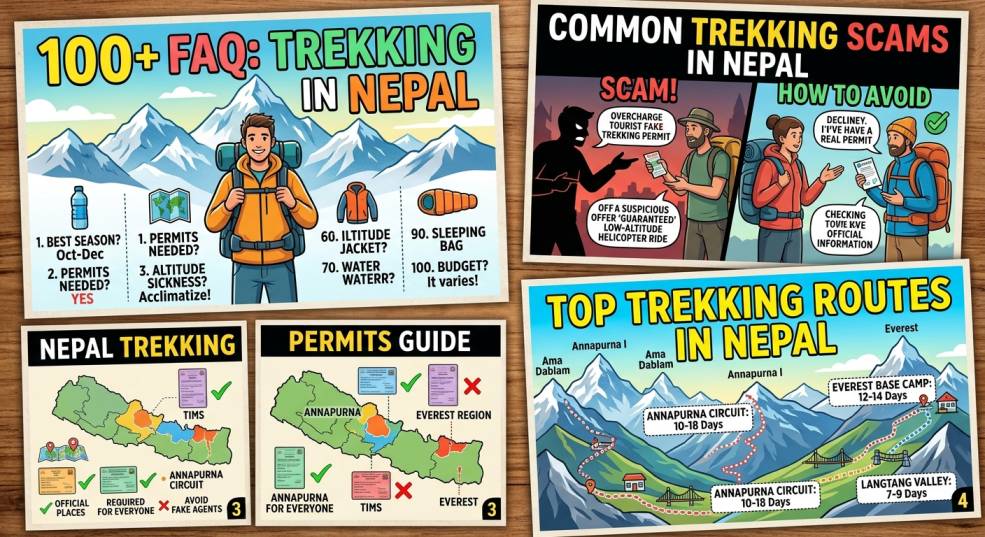
Nepal is a safe country with honest, hospitable people. But like any major tourist destination, it has its share of scammers who target inexperienced trekkers. From fake guides in Thamel to overpriced permits to outright helicopter rescue fraud, these scams cost tourists millions of dollars every year. This guide exposes the 12 most common Nepal trekking scams and shows you exactly how to avoid them.

1. The Fake Guide Scam in Thamel
Young men approach tourists in Thamel offering trekking services at “friend prices”. They claim to be licensed guides, show fake ID cards, and offer to organize your entire trek for half the agency price. They take a deposit, disappear, or deliver a substandard trek with no permits, no insurance, and no support. Real guides do not approach tourists in the street. Always book through a registered trekking agency with a physical office. See our Trekking-Firmenführer for vetting tips.
2. Permit Overcharging
Scammers sell TIMS cards and national park permits at inflated prices to tourists who do not know the official fees. TIMS card costs USD 20 (individual) or USD 10 (group) — not USD 50. Sagarmatha National Park costs USD 30, not USD 80. Manaslu Restricted Area Permit costs USD 100 per week peak season — not USD 300. Always buy permits yourself at the Nepal Tourism Board in Kathmandu or Pokhara, or through a registered agency that shows you the official receipts. See our permits guide for the full list of official fees.
3. Helicopter Rescue Fraud
This is the most lucrative scam in Nepal trekking. Unscrupulous agencies call helicopter rescues that are not medically necessary, bill your insurance USD 5,000-10,000, and split the payout with the helicopter company and clinic. The trekker is flown to Kathmandu unnecessarily, sometimes with mild symptoms that could have been treated by descending 500 m on foot. Symptoms of this scam: your guide insists on a helicopter when you feel fine, the rescue company calls your insurance without a doctor’s assessment, or you are pressured to sign insurance claim forms that exaggerate your symptoms. Always insist on a doctor’s assessment before authorizing a rescue, and never sign blank insurance forms. See our Hubschrauber-Rettungsführer for legitimate procedures.
4. Teahouse Commission Scam
Some guides take trekkers only to teahouses that pay them commission (NPR 100-300 per trekker per night), regardless of quality or your preference. You end up in overpriced, substandard lodges while better teahouses sit empty. Symptoms: your guide insists on a specific teahouse despite your request to stay elsewhere, becomes evasive when asked about commission, or refuses to let you compare options. Solution: book through a reputable agency with a no-commission policy, and ask your guide directly which teahouses they recommend and why.
5. Fake Trekking Gear in Thamel
Many Thamel shops sell fake branded gear — “The North Face” jackets with poor stitching, “Marmot” sleeping bags with low-loft down, “Salomon” boots that fall apart in a week. Prices are 30-50% of genuine gear. For casual use, fake gear may suffice; for a serious trek, fake gear is dangerous. Solution: buy from certified dealers (Shonas, Mountain Hardwear Genuine Store), check for proper labels and serial numbers, and trust your instincts — if the price seems too good, it is fake. See our gear guide for vetted shops.
6. The “Free” Trekking Offer
Someone offers you a “free” trek if you pay for permits and flights. The catch: they overcharge you 50-100% on permits, take you to commission teahouses, abandon you mid-trek, or steal from your bag. Free does not exist in Nepal trekking. A real guide costs USD 25-40 per day. If someone offers free services, walk away.
7. Overpriced Taxis from Kathmandu Airport
Taxi drivers at Tribhuvan International Airport quote tourists NPR 1,500-2,500 for a ride to Thamel that should cost NPR 500-700. They claim the meter is broken, demand cash, and refuse to negotiate. Solution: use the airport prepaid taxi counter (fixed NPR 700 to Thamel), or book a transfer through your hotel or trekking agency. Never get into a taxi without agreeing on the price first.
8. Fake ATM Machines
Some ATMs in Thamel are rigged with skimmers that copy your card data, or are entirely fake machines that swallow your card. Solution: use only ATMs inside major banks (Standard Chartered, Nabil, Himalayan, Nepal Investment Bank). Avoid standalone ATMs in tourist restaurants and shops. See our Geldautomat for safe withdrawal locations.
9. Visa Overstay Extortion
Nepal charges USD 3 per day for visa overstays, plus a USD 5 processing fee. Some immigration officials at the airport demand USD 100-500 in “fines” for a 1-2 day overstay, threatening to deny boarding if you do not pay. Solution: know the official fee (USD 3/day + USD 5), insist on a receipt, and ask to speak to a supervisor if extorted. Better: never overstay your visa. Extend at the Nepal Immigration Office in Kathmandu for USD 3/day before your visa expires.
10. The “Monastery Donation” Trick
At Boudhanath, Swayambhu, and other Buddhist sites, “monks” approach tourists offering blessings, then demand NPR 1,000-5,000 as a “donation”. Real monks do not solicit tourists. Solution: decline politely, walk away, and donate directly to the official donation boxes at monasteries. See our Klöster for legitimate visits.
11. Gem and Jewelry Scam
A friendly local strikes up a conversation, mentions a “special government gem auction” today only, and offers to take you. You are pressured to buy gems at 5-10x their value, with promises of reselling them at home for huge profit. The gems are worthless glass or low-grade stones. Solution: never buy gems from someone who approaches you on the street. Buy only from established jewelers with certificates.
12. Fake Trekking Reviews
Some trekking agencies pay for fake TripAdvisor and Google reviews, or post fake positive reviews of themselves. Symptoms: all 5-star reviews with similar language, review authors with only 1 review, reviews clustered in a short time period. Solution: read reviews across multiple platforms (TripAdvisor, Google, Lonely Planet, Reddit), look for detailed reviews with photos, and ask to speak to previous clients. See our Trekking-Firmenführer for vetting tips.
Häufig Gestellte Fragen (FAQ)
Is Nepal safe for tourists despite these scams?
Yes, Nepal is statistically very safe. Violent crime against tourists is rare. Most scams are financial and avoidable with basic awareness. Use registered agencies, buy permits at official offices, use bank ATMs, and trust your instincts. See our Trekking-Firmenführer for vetting tips.
How do I know if a helicopter rescue is legitimate?
A legitimate rescue requires: a doctor’s assessment at a Himalayan Rescue Association clinic or by phone, a recommendation from the doctor, pre-authorization from your insurance, and a written report from the rescue company. If your guide insists on a helicopter when you feel fine, refuses to call a doctor, or pressures you to sign blank insurance forms, refuse and call your agency directly. See our Hubschrauber-Rettungsführer for the legitimate protocol.
What should I do if I am scammed in Nepal?
Report to the Tourist Police in Kathmandu (phone 1144, or visit their office at Bhrikutimandap). They handle tourist scams and have a good record of recovering money. Also contact your embassy, your travel insurance provider, and post warnings on TripAdvisor and Reddit. If your trekking agency scammed you, file a complaint with TAAN (Trekking Agencies Association of Nepal).
Can I trust trekking agencies that offer very low prices?
Generally no. A 14-day EBC trek under USD 1,000 means corners are being cut on porter wages, gear, insurance, or food. Real costs for a quality trek are USD 1,200-1,800. If a price seems too good to be true, it is. Pay a fair price for fair treatment of staff and quality service. See our Trekking-Firmenführer for vetting criteria.
Trek Pathways is a fully licensed, transparent trekking agency with no hidden fees, no commission deals, and no rescue fraud. Browse our Manaslu Circuit Trek, Everest Base Camp Trekoder Annapurna Circuit Trek packages for a scam-free Himalayan experience.
 English
  Deutsch
  Français
  Português
  Español
0 Comment